Comparison
Bamboo vs wood cutting boards
One of these is a grass glued into a sheet and the other is a plank, and the honest difference between them is not the one everybody repeats.
We earn a commission when you buy through our Amazon links, at no extra cost to you. It never changes the order of the picks, and we say so when the cheaper thing is the better buy. How this works.
Every pick below is on Amazon Handmade unless the card says otherwise, and every price is the live one. If you want the rules we apply before anything gets listed, they are on how we pick.
The short answer
Quick picks
| # | Product | Best for | Provenance | Price |
|---|---|---|---|---|
| 01 | 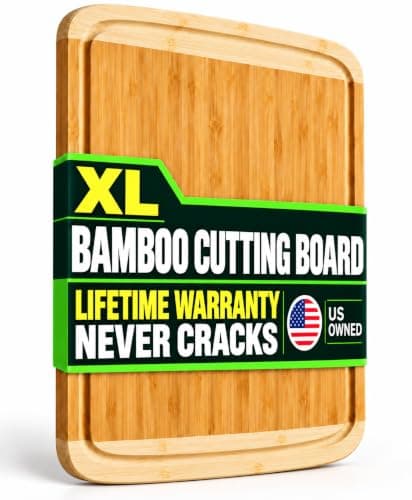 Greener Chef Extra Large Bamboo Board, 18 in The bamboo board to buy if you are buying bamboo: full size, vertical grain, and about a third the weight of a hardwood block. | a second board for vegetables, or a first board for somebody who will not oil one | Factory-made | $29.65Amazon (affiliate link) |
| 02 | 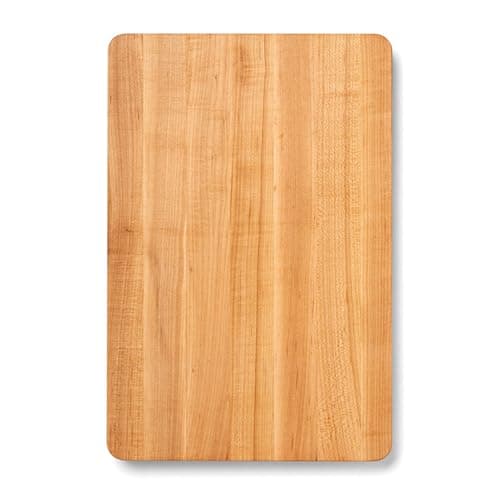 John Boos Chop-N-Slice Maple Board The default American maple edge grain board, made since long before any of this. | the reference point every other board on this page is measured against | Factory-made | $48.95Amazon (affiliate link) |
| 03 | 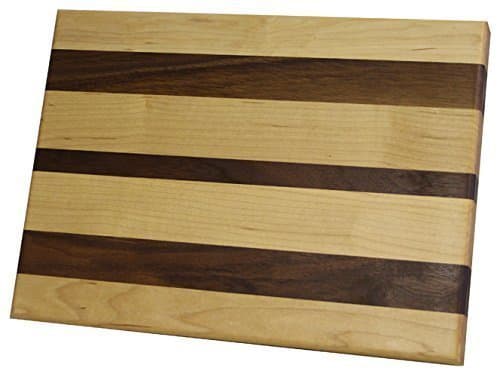 Maple and Walnut Cutting and Serving Board, 10 x 14 in The same footprint as the striped version, plainer, and cheaper for it. | a household that wants one board to chop on and serve from | Amazon Handmade | $70.00Amazon (affiliate link) |
| 04 | 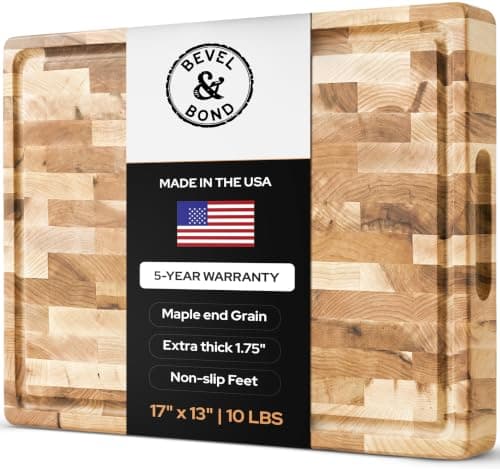 Maple End-Grain Board, 17 x 13 x 1.75 in Ten pounds of maple end grain, made in the USA per the listing, under the handmade price. | end grain at production pricing, with the dimensions stated up front | Factory-made | $119.99Amazon (affiliate link) |
| 05 | 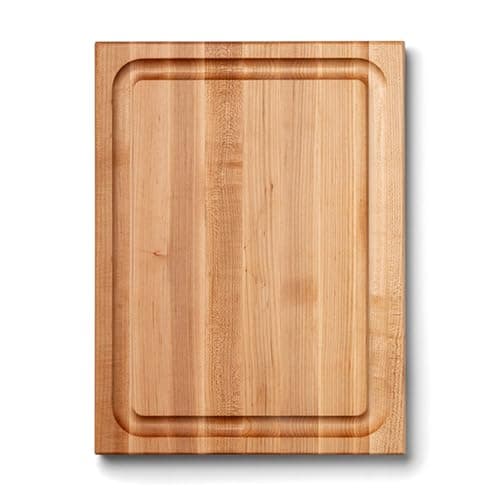 John Boos CB Series Reversible Maple Block, 20 x 15 in Twelve pounds of reversible maple at 1.5 in thick, and it will outlive the kitchen. | a serious home kitchen with counter space to spare | Factory-made | $129.95Amazon (affiliate link) |
| 06 | 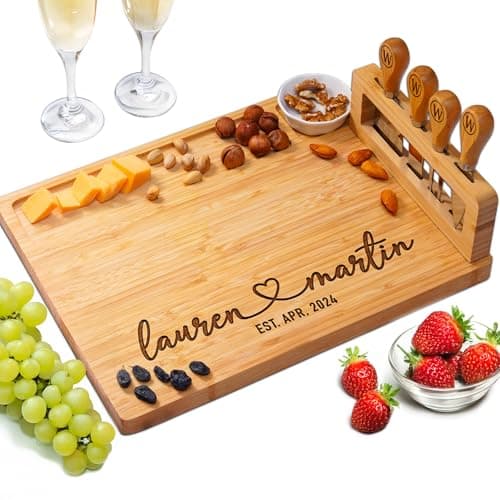 Personalized Bamboo Charcuterie Set with Knives A bamboo board with a knife set and an engraving, and bamboo is the compromise. | a complete gift in one box when the budget stops at twenty-five dollars | Factory-made | $24.90Amazon (affiliate link) |
| 07 | 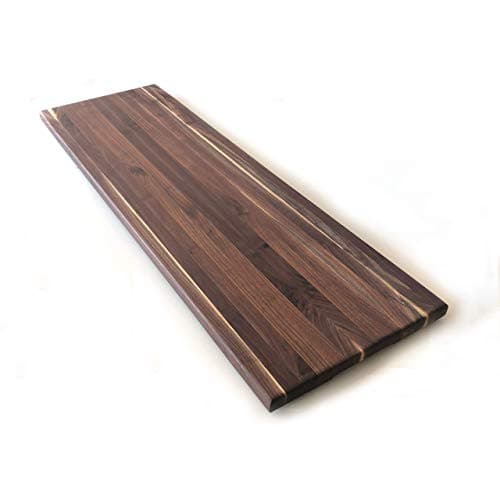 Extra-Large Black Walnut Edge Grain Board, 40 in, with Handles Forty inches of black walnut with built-in handles and rubber feet. | a long table and a genuinely large spread | Amazon Handmade | Check price (affiliate link) |
#ad · Live prices from the Amazon Creators API, as of November 9, 2026. Where we hold no verified live price we show none — a gap beats a number that has rotted.
The one we would not buy
Thin bamboo boards sold in three-piece sets with a knife and a stand
The format tells you the priority: three boards, a block of accessories and a price that has to cover all of it means the boards themselves are the cheapest part. They are typically a third of an inch or less, which is thin enough to cup within a season of washing, and the thinner the board the more the glue lines matter, because there is less material either side of them. If you want bamboo, buy one full-size board with a stated thickness. If you want three boards, buy one hardwood board and use a plate.
The picks, in full
Greener Chef Extra Large Bamboo Board, 18 in
by Greener Chef
For a light second board for vegetables, at the price bamboo is bought for. The bamboo board to buy if you are buying bamboo: full size, vertical grain, and about a third the weight of a hardwood block.
Bamboo's real advantages are weight and price, and this one leans on both: 18 by 12.5 inches at three pounds, where a hardwood board that size runs eight to twelve. The listing calls the construction vertical grain, which means the strips are glued on edge rather than face-down, and that is the stronger of the two cheap bamboo layups. At 0.63 inches it is thin enough to lift one-handed and thick enough not to cup immediately. Buy it as the board that lives on the counter for vegetables and lets a hardwood board stay nice.
Worth knowing first
Bamboo is a grass glued into sheets rather than a hardwood, and the glue lines are where these boards eventually split. On hardness it is a wash with hard maple rather than the knife-killer it gets called. Good serving and prep board, poor forever board: at 0.63 inches there is not enough material to sand it flat again.
Price as of November 9, 2026. Prices move, and the one on Amazon is the one that counts.
#ad we may earn a commission from this link to Greener Chef Extra Large Bamboo Board, 18 in
John Boos Chop-N-Slice Maple Board
by John Boos
For the smallest sensible step up from bamboo, in American maple. The default American maple edge grain board, made since long before any of this.
John Boos has been making maple butcher block in Illinois since the nineteenth century, and the Chop-N-Slice is the plain edge grain board most professional kitchens actually use. It is included here as the benchmark: if a handmade board costs more than this, it should be doing something this does not. Many do. Some do not.
Worth knowing first
Factory-made, and deliberately plain. Nobody will unwrap this and be surprised.
Price as of November 9, 2026. Prices move, and the one on Amazon is the one that counts.
#ad we may earn a commission from this link to John Boos Chop-N-Slice Maple Board
Maple and Walnut Cutting and Serving Board, 10 x 14 in
by Independent maker
For a board a person built rather than a factory pressed. The same footprint as the striped version, plainer, and cheaper for it.
This is the board to buy when the recipient is practical rather than decorative. It does both jobs a wooden board is asked to do and it does not announce itself on the table. At this price it is the strongest value in the section, and the one we would send to a first apartment.
Price as of November 9, 2026. Prices move, and the one on Amazon is the one that counts.
#ad we may earn a commission from this link to Maple and Walnut Cutting and Serving Board, 10 x 14 in
Maple End-Grain Board, 17 x 13 x 1.75 in
For end grain, where the blade parts the fibers instead of crossing them. Ten pounds of maple end grain, made in the USA per the listing, under the handmade price.
End grain from a small workshop generally starts well north of a hundred dollars, so a production board that states its construction, its dimensions and its weight is a genuine value option. The trade is character: this is uniform in a way a workshop board is not. It is the practical choice, not the sentimental one.
Worth knowing first
Factory-made. Buy it for the construction and the price, and do not present it as artisan.
Price as of November 9, 2026. Prices move, and the one on Amazon is the one that counts.
#ad we may earn a commission from this link to Maple End-Grain Board, 17 x 13 x 1.75 in
John Boos CB Series Reversible Maple Block, 20 x 15 in
by John Boos
For a full-size reversible block that outlives every bamboo board you would buy instead. Twelve pounds of reversible maple at 1.5 in thick, and it will outlive the kitchen.
This is a working butcher block rather than a gift object: heavy enough that it does not move while you chop, thick enough to be resurfaced repeatedly, and reversible so one face can stay for raw meat. Nobody gives this as a romantic gesture. Give it to someone who has complained about their board.
Worth knowing first
Factory-made, heavy, and it needs permanent counter space. Measure before buying.
Price as of November 9, 2026. Prices move, and the one on Amazon is the one that counts.
#ad we may earn a commission from this link to John Boos CB Series Reversible Maple Block, 20 x 15 in
Personalized Bamboo Charcuterie Set with Knives
by The Engraving Station
For a complete gift in a box under twenty-five dollars, labeled for what it is. A bamboo board with a knife set and an engraving, and bamboo is the compromise.
We are listing this as factory-made and pressed bamboo rather than solid hardwood, because that is what it is. What it does well is arrive complete: board, three cheese knives, a serving fork, four forks, labels, chalk, engraving — no assembly of a gift required. As a serving set for a housewarming it does the job. As a working board it will not last like the hardwood options above.
Worth knowing first
Pressed bamboo, not solid hardwood. It is a serving set, and it will not survive being used as a chopping block.
Price as of November 9, 2026. Prices move, and the one on Amazon is the one that counts.
#ad we may earn a commission from this link to Personalized Bamboo Charcuterie Set with Knives
Extra-Large Black Walnut Edge Grain Board, 40 in, with Handles
For a counter-length board in one species, where bamboo has no answer at all. Forty inches of black walnut with built-in handles and rubber feet.
This is a table-runner-sized serving board, and there is essentially no mass-market equivalent because the material cost at this length is prohibitive. Built-in handles and feet mean it can be carried loaded and set down without scratching. It is a statement purchase and it should be treated as one.
Worth knowing first
Forty inches. Confirm the table and the storage before ordering.
No buyable offer at the last price check (November 9, 2026). We show nothing rather than a stale number.
#ad we may earn a commission from this link to Extra-Large Black Walnut Edge Grain Board, 40 in, with Handles
The short version
Buy bamboo when the board is going to be light, cheap and replaceable: a second board for vegetables, a serving board, a gift that has to stay under twenty-five dollars. Buy hardwood when it is the board somebody will own in ten years. The decision is about thickness, glue lines and repairability rather than about hardness, which is where almost every version of this comparison goes wrong — including an earlier version of ours.
Bamboo is not a wood, and that is not an insult
Bamboo is a grass. The Wood Database files it under Poaceae, the grass family, and notes that as a monocot it has no sapwood, no heartwood and no growth rings — none of the structure that makes a plank behave like a plank. A bamboo culm is a hollow tube, so a bamboo board cannot be sawn from it. It is made by slicing the culm into strips and gluing those strips into a sheet, either face-down (horizontal grain) or on edge (vertical grain).
That manufacturing route is the whole character of the material. It is why bamboo boards are light, why they are cheap, why they are available in sizes that would cost three figures in hardwood, and why the adhesive is a structural component rather than an incidental one. A hardwood board is a piece of tree; a bamboo board is an engineered panel. Both can be perfectly good kitchen objects as long as you know which one you are buying.
Hardness: the claim everybody repeats, and the numbers
The standard line — ours included, until this page — is that bamboo is harder than maple and therefore blunts knives faster. The measured numbers do not support it. Janka hardness is the force needed to embed a steel ball halfway into the surface, and on the Wood Database it comes out like this.
What does affect your knives, on either material, is end grain versus edge grain and whether the surface has been allowed to dry out. End grain vs edge grain cutting boards covers the mechanism properly: on an end-grain board the blade parts the fibers and they close again, which is why those boards look newer for longer.
Where bamboo actually loses
Three places, and all three are consequences of how the panel is made rather than of what it is made from.
- Thickness. The bamboo board on this page is 0.63 inches, which is generous for the category; most are thinner. A hardwood working board is an inch or more. Thickness is what resists cupping and what allows a board to be sanded flat again years later, and a half-inch panel has no material to give.
- Glue lines. Every strip boundary is an adhesive joint, and a glued joint is where water gets in and where a board eventually splits. Hardwood boards have glue lines too — a maple-and-walnut board is a laminate — but there are far fewer of them per square inch and the pieces either side are thick.
- Repairability. This is the real distinction. A hardwood board that has been scarred and gone gray comes back with a sander and oil, and people do this to boards their parents owned. A bamboo board cannot be meaningfully resurfaced, so when it looks finished, it is finished.
Water, warping and the dishwasher question
Neither material goes in a dishwasher if you want to keep it, and the reason is not hygiene. A dishwasher combines prolonged soaking with a hot dry cycle, which is exactly the combination that swells and then shrinks a glued panel until the joints fail. On a bamboo board that shows up as strips lifting at the edges; on a hardwood board it shows up as a split along a glue line or a cup you can rock a knife on.
Worth knowing that public-health guidance is narrower than maker guidance here. The University of Maine Extension's cutting-board page says nonporous boards and solid wood boards can be cleaned in a dishwasher, because it is answering a food-safety question. Every board maker says the opposite, because they are answering a durability question. Both are right about their own question, and the practical answer is the same either way: hot soapy water, rinse, stand it on edge to dry. The same split shows up in ceramics, where the machine question is decided piece by piece rather than material by material — are handmade mugs dishwasher safe? works that one through.
Bamboo's one genuine advantage in this department is that it absorbs less water than most hardwoods and dries faster, which is why it suits a household that will not oil a board. Hardwood needs feeding a few times a year to stay stable — how to oil a cutting board is the two-minute routine, and board butter vs mineral oil settles which product to use.
The glue, and the one label worth checking
Because a bamboo board is held together by adhesive, the adhesive is a fair question. In the US the relevant standard is TSCA Title VI, the EPA's formaldehyde emission rule for composite wood products, which covers hardwood plywood, particleboard and medium-density fiberboard and the finished goods made from them. Compliant products carry a label stating TSCA Title VI or CARB Phase 2 compliance, and the rule includes provisions for laminated products.
A kitchen board is not the same category as a sheet of plywood, and we are not going to claim your cutting board is a hazard. What we will say is that a manufacturer willing to state compliance on the listing is telling you something about how the panel was made, and that a listing with no material statement at all — not the species, not the thickness, not the glue — is telling you something too. Ask the same question of a cheap hardwood board: a board described only as premium hardwood is not naming a species because naming it would not help the sale.
Food safety, which is a wash
This is the oldest argument in the category and it is largely settled, in a way that favors neither material strongly. Both bamboo and hardwood are porous enough to be criticized and clean enough in practice to be used by millions of households. The extension-service guidance that matters is behavioral rather than material: wash with hot soapy water after every use, dry it, keep a separate board for raw meat and poultry, and replace any board with deep grooves, because grooves are where cleaning fails on every material including plastic.
Wood vs plastic cutting boards is the full version of that comparison, including why the old assumption about wood turned out to be weaker than it looked.
What to buy at each budget
- Under $25
- Bamboo, honestly. At this price a hardwood board is either tiny, thin or a serving board with engraving on it. Buy one full-size bamboo board with a stated thickness rather than a three-piece set, or buy the bamboo gift set and treat it as a serving kit.
- $40 to $80
- The band where real hardwood arrives: a maple block from a long-established maker, or a maple-and-walnut board from an individual workshop. This is the single best value jump in the category and the one we would push a reader toward.
- $100 and up
- End grain, large formats and single species. This is where boards stop being equipment and start being furniture that happens to work — and where bamboo has no answer, because the sizes and thicknesses simply are not made in it.
If you are buying for someone else rather than for yourself, the species question matters less than the size question. What size cutting board has the measurements, cutting board wood types names what each species does, and personalized cutting boards covers engraving — which, if the board is bamboo, is usually the actual point of the gift.
The verdict, stated plainly
Bamboo is a good cheap board and a bad expensive one, and it is not the knife-wrecker it gets called. Hardwood is a good expensive board and a compromised cheap one, because at the bottom of the hardwood range you are paying for engraving on thin stock. The line falls at roughly forty dollars: below it, buy bamboo and expect to replace it; above it, buy hardwood and expect to keep it.
Questions people actually ask
Does bamboo dull knives faster than wood?
Is bamboo actually wood?
Can a bamboo cutting board go in the dishwasher?
Do bamboo boards need oiling?
Which is better for serving, bamboo or hardwood?
Sources
- The Wood Database — Bamboo: Poaceae (grass) family, Janka 1,410-1,610 lbf, glued strip construction
- The Wood Database — Hard Maple: Janka 1,450 lbf, listed uses include cutting boards and butcher block
- EPA — Formaldehyde Emission Standards for Composite Wood Products (TSCA Title VI, 40 CFR Part 770)
- University of Maine Cooperative Extension — Cutting Board Safety
Read next
Head to head
Wood vs plastic cutting boards
What the bacteria studies actually found, why the official advice still says nonporous, and why a scarred plastic board is the one to throw out.
Comparison
Maple, walnut, cherry — and what to avoid
Species by species: hardness, staining, aging, and the ones to avoid.
Comparison
End grain vs edge grain
The construction difference, what it costs, and who should pay for it.
Care
Wooden cutting board care
The four-minute routine that decides whether a board lasts one year or thirty.