Roundup
Walnut cutting boards
Most boards sold as walnut are walnut and maple. That is not a scam - but it is the first thing to establish before you spend.
The verdict
Top pick · Boards by the Bay Extra-Large Black Walnut Board, 24 x 18 in
#ad · price as of November 23, 2026
Budget pick · Two-Tone Maple and Walnut Engraved Board
#ad · price as of November 23, 2026
Top pick: the Boards by the Bay extra-large black walnut board. It is the only board here that is solid black walnut at a size that changes what you can do on a counter: a stated 24 by 18 by 2 inches, with a juice groove, built-in handles and rubber feet, handmade in Michigan. Two inches of hardwood is the thickness at which a board stops moving when you lean on it, and the handles are what make a board that heavy usable rather than ornamental.
Budget pick: the two-tone maple and walnut engraved board. Walnut laminated to maple and then engraved, so the wood does half the decorative work — the cheapest way onto this page, and the one to buy in quantity.
We earn a commission when you buy through our Amazon links, at no extra cost to you. It never changes the order of the picks, and we say so when the cheaper thing is the better buy. How this works.
Every pick below is on Amazon Handmade unless the card says otherwise, and every price is the live one. If you want the rules we apply before anything gets listed, they are on how we pick.
The short answer
Quick picks
| # | Product | Best for | Provenance | Price |
|---|---|---|---|---|
| 01 | 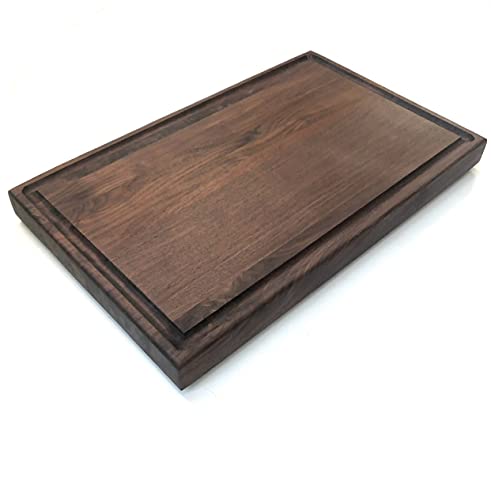 Boards by the Bay Extra-Large Black Walnut Board, 24 x 18 in Two inches of Michigan black walnut, 24 by 18, with a juice groove, built-in handles and rubber feet. | a genuinely large spread, and a board meant to be the last one they are given | Maker-direct | $299.29Amazon (affiliate link) |
| 02 | 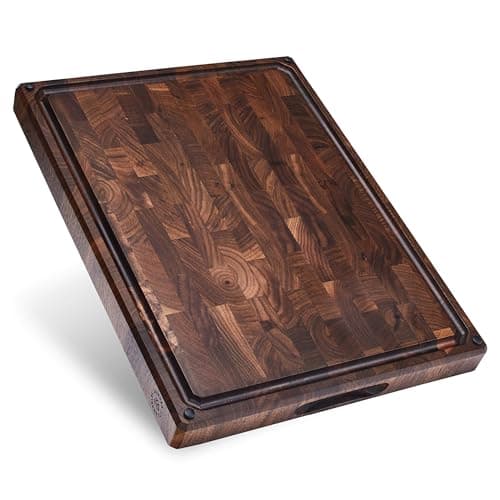 Sonder Los Angeles Alfred End Grain Walnut Board Production end grain walnut, 17 x 13 x 1.5 in, and the specs are stated plainly. | someone who wants end grain walnut at a known brand with a return policy | Factory-made | $179.99Amazon (affiliate link) |
| 03 | 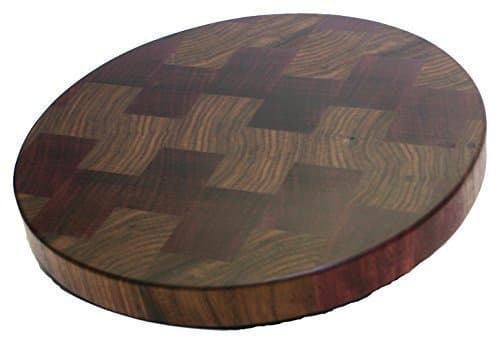 Purpleheart and Walnut Round Board, 12 in A round board in purpleheart and walnut, which is a color combination nobody expects. | the person who has a perfectly good board and wants an object | Amazon Handmade | $115.00Amazon (affiliate link) |
| 04 | 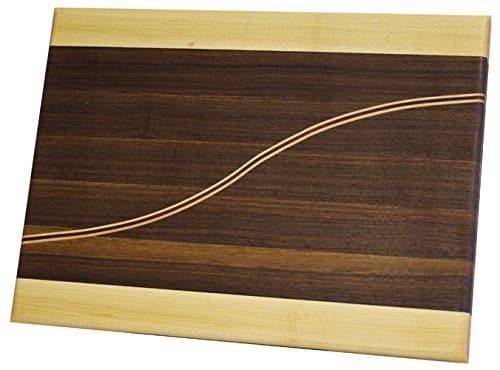 Walnut and Maple Board with Stripe, 10 x 14 in The size most people actually use, in the two-wood combination that never dates. | the everyday board that lives on the counter | Amazon Handmade | $90.00Amazon (affiliate link) |
| 05 | 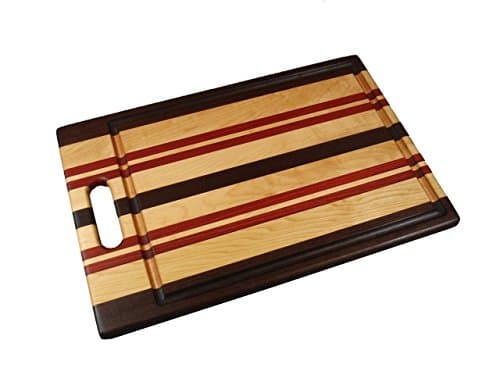 Highlight Series Large Board with Handle, Walnut, Maple and Padauk Large, handled, and padauk gives it an orange-red stripe you cannot get from stain. | a big kitchen and someone who entertains | Amazon Handmade | $85.00Amazon (affiliate link) |
| 06 | 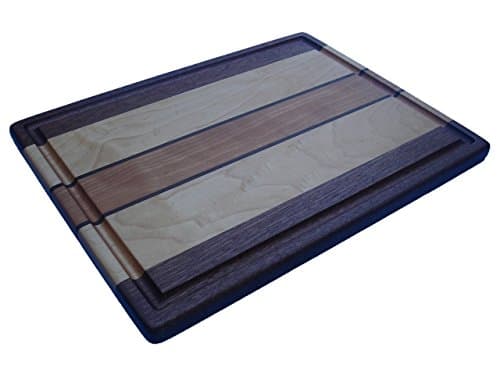 Signature Collection Large Board, Sapele, Maple, Walnut and Cherry Four woods laminated into stripes, large format, from a Handmade workshop. | a wedding or housewarming gift that has to look like an heirloom | Amazon Handmade | $75.00Amazon (affiliate link) |
| 07 | 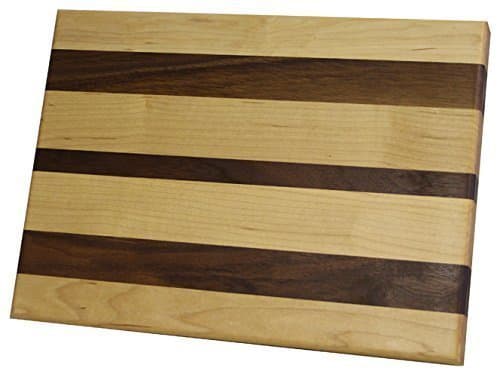 Maple and Walnut Cutting and Serving Board, 10 x 14 in The same footprint as the striped version, plainer, and cheaper for it. | a household that wants one board to chop on and serve from | Amazon Handmade | $70.00Amazon (affiliate link) |
| 08 | 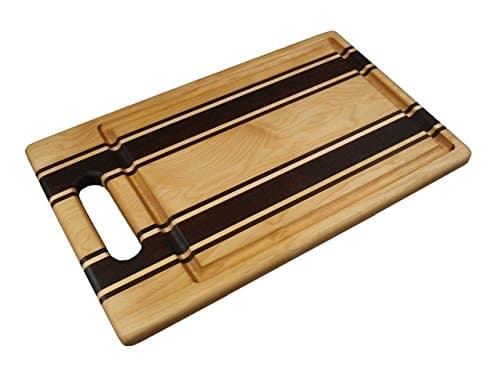 Cabin Series Medium Board with Handle, Maple and Walnut Medium, handled, two woods, from the same workshop as the larger pieces. | the best handmade board you can get for around sixty-five dollars | Amazon Handmade | $65.00Amazon (affiliate link) |
| 09 | 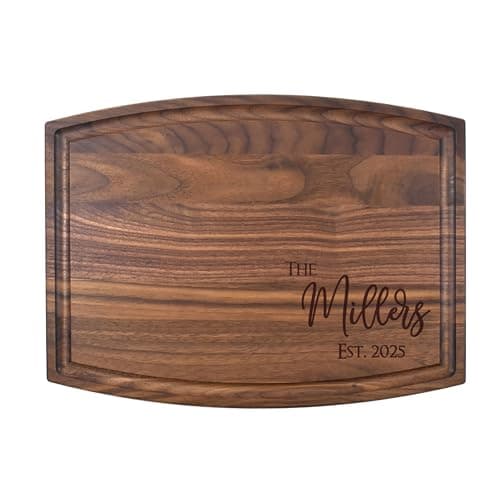 Custom Engraved Walnut Board, 9 x 12 in with Groove Solid walnut with a juice groove, engraved to order, at around fifty dollars. | a personalized board where the wood is the point, not the engraving | Amazon Handmade | $49.00Amazon (affiliate link) |
| 10 | 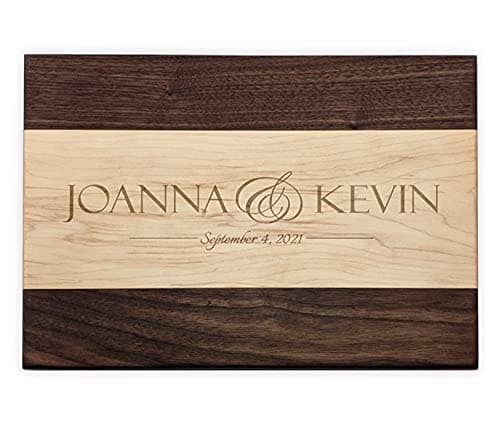 Two-Tone Maple and Walnut Engraved Board Maple and walnut laminated together, then engraved, so the wood is doing half the work. | an engraved gift that still looks like a piece of woodwork | Amazon Handmade | $36.70Amazon (affiliate link) |
#ad · Live prices from the Amazon Creators API, as of November 23, 2026. Where we hold no verified live price we show none — a gap beats a number that has rotted.
The one we would not buy
Dark boards described as "walnut finish", "walnut stained" or "walnut color"
Those three phrases are the tell that the wood is not walnut. Walnut is expensive because the tree is slow-growing and the usable heartwood is a fraction of the log, so a dark board at a rubberwood price is a cheap pale hardwood with pigment on it. The problem is not honesty alone, it is that the color is a surface. A cutting board gets cut, and every knife mark through a stained surface exposes the pale wood underneath, so within a season the board is a dark surface with white scratches all over it. Solid walnut is dark all the way through, so a cut shows walnut. If the budget does not reach walnut, buy honest maple instead - it is a harder wood and it is supposed to be pale.
The picks, in full
Boards by the Bay Extra-Large Black Walnut Board, 24 x 18 in
by Boards by the Bay
For a genuinely large spread, and a board meant to be the last one they are given. Two inches of Michigan black walnut, 24 by 18, with a juice groove, built-in handles and rubber feet.
This is the top of the category rather than a bigger version of a mid-priced board: two inches of solid black walnut at this footprint is a quantity of timber with no mass-market equivalent, which is most of why the number is what it is. The listing states the species, the size and the workshop — Harbor Springs, Michigan — and the groove, the built-in handles and the non-slip feet mean it carves and serves without sliding or running onto the table. It is a statement purchase and it should be treated as one.
Worth knowing first
Two inches of walnut at this footprint is heavy, and it is the most expensive thing on the page by a wide margin. Confirm there is somewhere to keep it out. It came back outside the Amazon Handmade index, so we label it maker-direct rather than handmade.
Price as of November 23, 2026. Prices move, and the one on Amazon is the one that counts.
#ad we may earn a commission from this link to Boards by the Bay Extra-Large Black Walnut Board, 24 x 18 in
Sonder Los Angeles Alfred End Grain Walnut Board
by Sonder Los Angeles
For end grain walnut from a brand with a stated spec and a return policy. Production end grain walnut, 17 x 13 x 1.5 in, and the specs are stated plainly.
We label this factory-made because it is, and we include it because it is a real end grain walnut board at a size and thickness the listing actually states. Production boards win on consistency and on returns: if it arrives warped you send it back, which is not always simple with a one-person workshop. If the maker story matters to the recipient, buy handmade instead.
Worth knowing first
Mass-produced. It carries no maker story, which for a gift is often the entire point.
Price as of November 23, 2026. Prices move, and the one on Amazon is the one that counts.
#ad we may earn a commission from this link to Sonder Los Angeles Alfred End Grain Walnut Board
Purpleheart and Walnut Round Board, 12 in
by Independent maker
For someone who already owns a working board and wants an object. A round board in purpleheart and walnut, which is a color combination nobody expects.
Purpleheart really is purple, and it is the wood that makes people pick up a board and ask what it is. Round format pushes it further toward serving than chopping. This is a decorative buy and we would rather say so than pretend it is the practical choice, because the 10 x 14 rectangles above are better at the actual job.
Worth knowing first
Bought for looks. If they need a working board, this is not it.
Price as of November 23, 2026. Prices move, and the one on Amazon is the one that counts.
#ad we may earn a commission from this link to Purpleheart and Walnut Round Board, 12 in
Walnut and Maple Board with Stripe, 10 x 14 in
by Independent maker
For the board that lives on the counter and gets used daily. The size most people actually use, in the two-wood combination that never dates.
Ten by fourteen is the board that stays out. Anything larger gets put away and therefore does not get used, which is the quiet reason expensive big boards disappoint. Walnut and maple is the default pairing for a reason: maximum contrast, both woods hard enough for the job, and neither one exotic enough to be hard to replace.
Price as of November 23, 2026. Prices move, and the one on Amazon is the one that counts.
#ad we may earn a commission from this link to Walnut and Maple Board with Stripe, 10 x 14 in
Highlight Series Large Board with Handle, Walnut, Maple and Padauk
by Independent maker
For a big kitchen, and a board that has to look like something on a table. Large, handled, and padauk gives it an orange-red stripe you cannot get from stain.
Padauk is bright orange when freshly cut and mellows to a deep red-brown, so this board changes character over its first year in the same way cherry does. Large format with a handle is the entertaining configuration: it carries a full cheese course. It is a lot of board, so check they have somewhere to put it.
Price as of November 23, 2026. Prices move, and the one on Amazon is the one that counts.
#ad we may earn a commission from this link to Highlight Series Large Board with Handle, Walnut, Maple and Padauk
Signature Collection Large Board, Sapele, Maple, Walnut and Cherry
by Independent maker
For a wedding or housewarming gift that has to read as an heirloom. Four woods laminated into stripes, large format, from a Handmade workshop.
Mixed-species boards are how a small shop shows what it can do: every glue line has to be perfect or the board fails in the first year. The color range here comes from the woods themselves rather than stain, so it will not fade to one tone. Large format means it works as a serving surface as well as a chopping one.
Price as of November 23, 2026. Prices move, and the one on Amazon is the one that counts.
#ad we may earn a commission from this link to Signature Collection Large Board, Sapele, Maple, Walnut and Cherry
Maple and Walnut Cutting and Serving Board, 10 x 14 in
by Independent maker
For a household that wants one board to chop on and serve from. The same footprint as the striped version, plainer, and cheaper for it.
This is the board to buy when the recipient is practical rather than decorative. It does both jobs a wooden board is asked to do and it does not announce itself on the table. At this price it is the strongest value in the section, and the one we would send to a first apartment.
Price as of November 23, 2026. Prices move, and the one on Amazon is the one that counts.
#ad we may earn a commission from this link to Maple and Walnut Cutting and Serving Board, 10 x 14 in
Cabin Series Medium Board with Handle, Maple and Walnut
by Independent maker
For a small kitchen where the board has to hang or stand. Medium, handled, two woods, from the same workshop as the larger pieces.
This is the sweet spot of the whole woodcraft section: it is genuinely handmade, it is the right size to be used daily, and it sits at a price a lot of people are comfortable spending on someone they like but are not related to. If you want one recommendation from this page and do not want to think about it, take this one.
Price as of November 23, 2026. Prices move, and the one on Amazon is the one that counts.
#ad we may earn a commission from this link to Cabin Series Medium Board with Handle, Maple and Walnut
Custom Engraved Walnut Board, 9 x 12 in with Groove
by Independent maker
For a personalized board where the wood is the point, not the engraving. Solid walnut with a juice groove, engraved to order, at around fifty dollars.
A juice groove is the detail that separates a carving board from a chopping board: it catches what comes out of a roast instead of sending it across the counter. Add walnut rather than a pale budget hardwood and you have a personalized gift that stands up on its own terms. This is the version to buy if the engraved boards above feel too thin.
Price as of November 23, 2026. Prices move, and the one on Amazon is the one that counts.
#ad we may earn a commission from this link to Custom Engraved Walnut Board, 9 x 12 in with Groove
Two-Tone Maple and Walnut Engraved Board
For an engraved gift that still looks like a piece of woodwork. Maple and walnut laminated together, then engraved, so the wood is doing half the work.
Most engraved boards are a single pale wood chosen because laser marks show up on it. This one is a two-tone lamination, so even before the engraving it looks like something a person made. At around thirty-five dollars it sits between the very cheap engraved blanks and the fifty-plus walnut boards.
Price as of November 23, 2026. Prices move, and the one on Amazon is the one that counts.
#ad we may earn a commission from this link to Two-Tone Maple and Walnut Engraved Board
The verdict, before the detail. The top pick is the Boards by the Bay extra-large black walnut board — solid walnut, 24 by 18 by 2 inches stated, with a groove, handles and feet. The budget pick is the two-tone maple and walnut engraved board. For end grain walnut with a stated spec and a return policy, the Sonder Alfred; for the size most people actually use every day, the 10 by 14 walnut and maple stripe; for a personalized board where the wood still leads, the engraved 9 by 12 solid walnut. The purpleheart round is the one bought as an object rather than a tool.
Solid walnut, or walnut and maple
This is the distinction the category never makes clearly, and it decides what you are buying. Walnut is one of the more expensive domestic hardwoods, so a board that is walnut all the way through costs real money. A great many boards sold under the word walnut are laminates: strips of walnut glued alternately with strips of maple, which is cheaper, visually striking, and genuinely more stable than a single species, because alternating grain directions resist the seasonal movement that cups a solid board.
Neither is better in the abstract. What matters is that you know which one you are getting, because they behave differently and they are priced differently. On this page the listings say which is which, and the split is: three solid walnut (the Boards by the Bay slab, the Sonder end grain, the engraved 9 by 12) and six laminates that include walnut as one of two to four woods, plus one round that pairs walnut with purpleheart.
- Solid walnut
- Dark through the whole thickness, so a knife cut exposes more walnut rather than a pale stripe. Heavier than it looks and the most expensive way to buy the species. Needs oiling to stay dark, because walnut lightens with UV rather than darkening the way cherry does.
- Walnut and maple laminate
- Alternating strips, which is the construction most handmade boards use. More dimensionally stable than one wide slab, noticeably cheaper, and the stripe is the design. The glue lines are the thing to inspect - they should be invisible and tight, with no gap you can catch a fingernail in.
- Walnut with an accent species
- Padauk gives an orange-red stripe, purpleheart a genuine violet, sapele a reddish brown. These are real wood colors rather than stain, which is why they survive being cut on. One pick here is walnut, maple and padauk; another is walnut with purpleheart.
- Walnut veneer or walnut finish
- Not on this page and not worth buying for food. A veneer is a paper-thin layer over a cheaper core, and a cutting board is the one object guaranteed to cut through it.
Grain direction matters more than species
If durability is the priority, the construction question is a bigger lever than the wood. An edge grain board presents the long sides of the wood fibers to the knife; an end grain board presents the fiber ends, like a bundle of straws stood upright, so the blade parts the fibers and they close again. End grain is kinder to an edge and hides cut marks better. It also costs more, weighs more and needs more oil, because exposed fiber ends drink it.
One pick here is stated end grain — the Sonder Alfred, at 17 by 13 by 1.5 inches — and the rest are edge grain or laminated edge grain. End grain versus edge grain cutting boards is the full comparison if that is the open question, and cutting board wood types is the four-species version of the material argument, where walnut sits against maple, cherry and the woods to avoid.
Size is the spec people get wrong
Board size is chosen from a photograph and then regretted on a counter. The useful way to pick is to decide what the board is for first, because the three common jobs want three different footprints, and a board that is too big for the sink is a board that gets wiped rather than washed.
Thickness, feet and the juice groove
- Thickness. Around an inch and a quarter is the handmade norm and is plenty for a board that lives on a counter. At two inches a board stops shifting when you lean into it and starts being furniture; it is also heavy enough that you will not move it often, which is a feature on a big board and an annoyance on a small one.
- Rubber feet. They lift the board so air reaches the underside, which is what stops the trapped-moisture cupping that ruins boards left flat on a wet counter. Only the top pick states them. On a board without feet, store it on edge.
- A juice groove. Worth it on a board used for roasted meat and a nuisance on a board used for daily vegetable prep, because the groove eats usable surface and collects onion. Two picks state a groove.
- Handles. The difference between a large board being used and being admired. Three picks state a handle or built-in handles; on a 24-inch slab it is close to essential.
- Reversible. A board with no groove and no feet can be flipped, which doubles its life. A board with both is one-sided by design.
What walnut actually does in a kitchen
Three practical things, and one of them runs the opposite way to what people expect. First, walnut is a softer hardwood than maple, which is why it is kinder to knife edges and why it also shows cut marks sooner. On an edge grain walnut board those marks accumulate into a visible working surface within a year or two. That is the normal life of a board, not damage, and it is the trade for the gentler edge.
Second, walnut does not darken with age the way cherry famously does — it goes the other way, lightening and slightly graying under direct sunlight. The fix is the same thing that maintains any board: oil it, and keep it off a sunny windowsill. An oiled walnut board looks close to how it looked when it arrived; a dry one looks dusty and gray.
Third, the color is doing real work for a reason nobody mentions: dark wood hides stains. Turmeric, beetroot, red onion and berries all mark a pale maple board permanently and are nearly invisible on walnut. If the board is going to a household that cooks with color, walnut is the practical choice rather than the decorative one.
Care, specifically for walnut
No board on this page goes in a dishwasher — the combination of heat, detergent and a long soak opens glue lines and cups solid slabs, and it is the fastest way to destroy a hundred-dollar object. Wash by hand with warm water, dry it standing on edge, and oil it when water stops beading and starts soaking in, which on a daily-use board is roughly monthly at first and quarterly once it is seasoned.
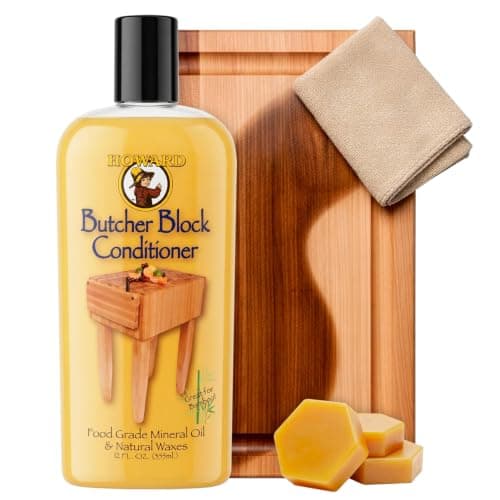
Use food-grade mineral oil, or a board butter that blends mineral oil with beeswax — the wax slows evaporation and leaves a slightly better surface feel. Do not use olive oil or any cooking oil: they are not stable and they go rancid in the wood. How to oil a cutting board is the routine, board butter versus mineral oil is the product choice, and wooden cutting board care covers the rest including raw meat.
The specs we could check, from the listings
What each pick gives up
- Boards by the Bay black walnut — far and away the most expensive board here, too big for most sinks, and heavy enough that it is a permanent counter resident rather than something you put away.
- Sonder Alfred end grain — factory-made and its card says so; end grain drinks oil, so it needs the care routine more often than anything else on this page.
- Purpleheart and walnut round — a round board wastes surface for chopping and the purple is a strong commitment in a kitchen somebody else chose.
- Walnut and maple stripe — a laminate, so it is walnut as one of two woods, and the listing states no finish or feet.
- Highlight series handled — no dimensions stated at all beyond large, which makes it a gamble as a gift for a kitchen you have not seen.
- Signature large — four woods is a lot of visual activity, and again no measurement beyond large format.
- Maple and walnut serving — deliberately plainer than the striped version, so it reads as less of a gift even though it is the same footprint.
- Cabin series medium — medium is undefined on the listing, and a handled board loses some of its surface to the handle.
- Engraved walnut 9 x 12 — small, made to order so not returnable, and a juice groove on a board this size eats a real share of the working area.
- Two-tone engraved — the thinnest listing here: no size and no thickness, and the engraving is doing more of the work than the wood.
Buying a walnut board as a gift
Two rules make this reliable. Buy the 10 by 14 footprint if you have not seen their kitchen — it fits a standard sink, it handles a whole chicken, and it is the size people actually reach for. And if you are engraving it, put the wood first: a solid walnut board with a small engraving reads as a piece of woodwork with a name on it, while a pale board with a large engraved design reads as a printed object. The engraved 9 by 12 solid walnut is the pick that gets that balance right.
Engraved boards are made after you order, so the lead time is production rather than shipping and they are not returnable once cut. What to engrave on a cutting board covers what actually reads well on hardwood, and a bottle of conditioner alongside the board is the pairing that signals you know how boards die — how to oil a cutting board explains why.
If the species is not the constraint, the wider pages are better entry points: handmade cutting boards is the main roundup sorted by quality and type, cutting boards under $100 and under $50 are the price bands, and charcuterie boards is the serving-first version of the same shelf.
Every price on this page is the live one, read when the page is served and stamped with its date under the Quick Picks table. Walnut moves with hardwood supply more than most categories here, which is one more reason no number appears in this prose.
Questions people actually ask
Is walnut a good wood for a cutting board?
What is the difference between solid walnut and a walnut and maple board?
Does walnut darken over time?
Avoid walnut finish or walnut stained boards?
Can a walnut cutting board go in the dishwasher?
What size walnut cutting board should I buy?
Read next
Woodcraft
Woodcraft, boards and bowls
Grain direction, species, and why the dishwasher is the enemy.
Roundup
Handmade wood cutting boards
Eight boards from real workshops, with the grain question settled first.
Comparison
Maple, walnut, cherry — and what to avoid
Species by species: hardness, staining, aging, and the ones to avoid.
Comparison
End grain vs edge grain
The construction difference, what it costs, and who should pay for it.
Buying handmade
What size cutting board do you need?
Counter, sink, biggest job: the three measurements that settle board size, with maker-made boards at each size.
Care
How to oil a cutting board
Which oil, how often, and the two that go rancid.