Alternatives
John Boos alternatives
A hundred-and-thirty-eight-year-old factory makes a very good plain board. Here is what beats it on construction, on wood, or on price.
The verdict
Top pick · Maple and Walnut Cutting and Serving Board, 10 x 14 in
#ad · price as of November 9, 2026
Budget pick · Custom Engraved Walnut Board, 9 x 12 in with Groove
#ad · price as of November 9, 2026
Top pick: the maple and walnut cutting and serving board, 10 x 14 in, which is the closest thing here to a Boos in function and comes from an independent workshop instead of a plant — same job, two woods instead of one, and under the price of the Boos reversible block.
Budget pick: the custom engraved walnut board with a juice groove — solid walnut at roughly the price of the entry-level Boos, and the cheapest alternative here that is a maker's own board rather than a bought-in blank.
We earn a commission when you buy through our Amazon links, at no extra cost to you. It never changes the order of the picks, and we say so when the cheaper thing is the better buy. How this works.
Every pick below is on Amazon Handmade unless the card says otherwise, and every price is the live one. If you want the rules we apply before anything gets listed, they are on how we pick.
The short answer
Quick picks
| # | Product | Best for | Provenance | Price |
|---|---|---|---|---|
| 01 | 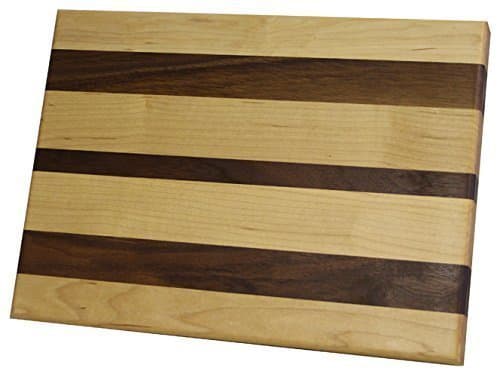 Maple and Walnut Cutting and Serving Board, 10 x 14 in The same footprint as the striped version, plainer, and cheaper for it. | a household that wants one board to chop on and serve from | Amazon Handmade | $70.00Amazon (affiliate link) |
| 02 | 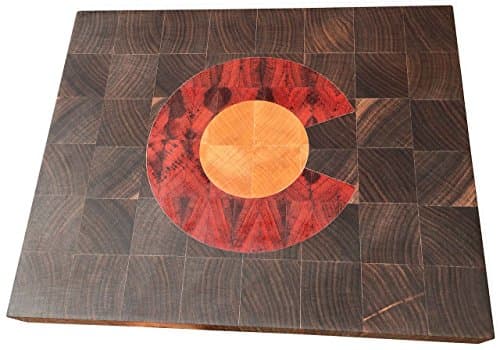 Colorado End Grain Cutting Board A true end grain block from a Handmade storefront, at the price where end grain starts. | the cook who actually chops, and who will keep this for twenty years | Amazon Handmade | $125.00Amazon (affiliate link) |
| 03 | 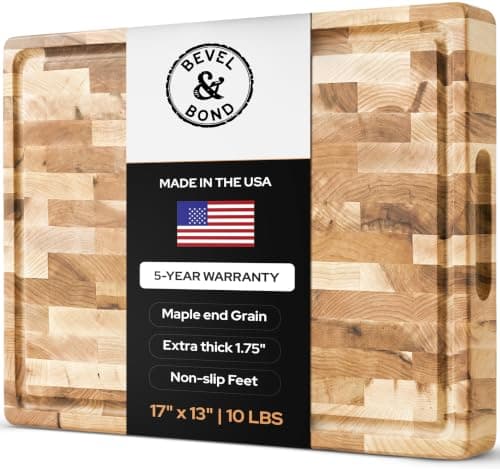 Maple End-Grain Board, 17 x 13 x 1.75 in Ten pounds of maple end grain, made in the USA per the listing, under the handmade price. | end grain at production pricing, with the dimensions stated up front | Factory-made | $119.99Amazon (affiliate link) |
| 04 | 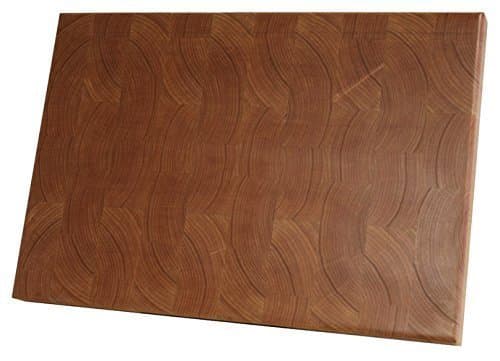 American Cherry Board, 12 x 18 in Single-species cherry, large, and it will darken to a deep red over a few years. | someone who wants a board that gets better looking with age | Amazon Handmade | $110.00Amazon (affiliate link) |
| 05 | 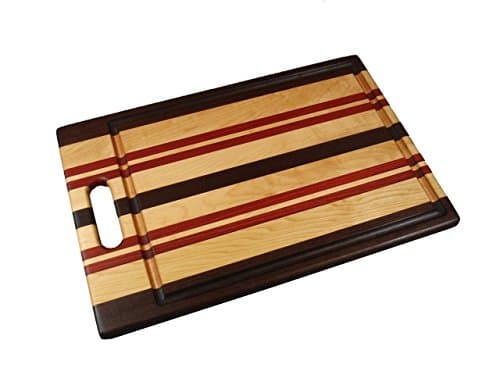 Highlight Series Large Board with Handle, Walnut, Maple and Padauk Large, handled, and padauk gives it an orange-red stripe you cannot get from stain. | a big kitchen and someone who entertains | Amazon Handmade | $85.00Amazon (affiliate link) |
| 06 | 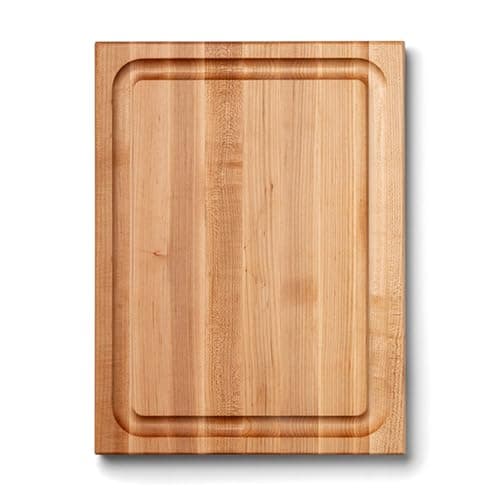 John Boos CB Series Reversible Maple Block, 20 x 15 in Twelve pounds of reversible maple at 1.5 in thick, and it will outlive the kitchen. | a serious home kitchen with counter space to spare | Factory-made | $129.95Amazon (affiliate link) |
| 07 | 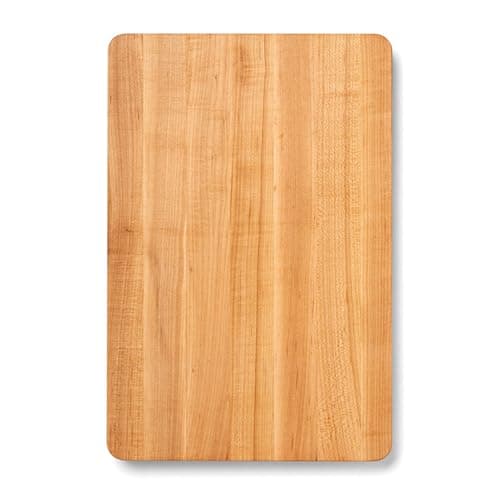 John Boos Chop-N-Slice Maple Board The default American maple edge grain board, made since long before any of this. | the reference point every other board on this page is measured against | Factory-made | $48.95Amazon (affiliate link) |
| 08 | 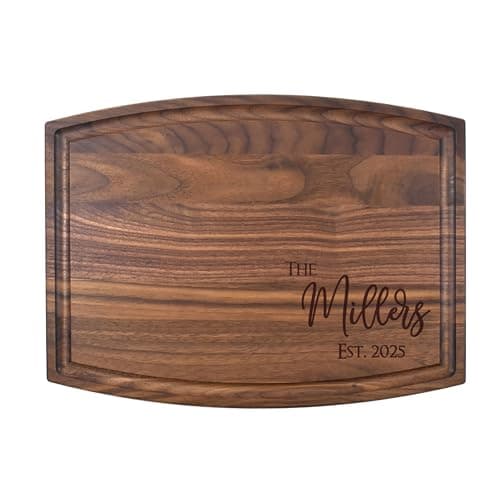 Custom Engraved Walnut Board, 9 x 12 in with Groove Solid walnut with a juice groove, engraved to order, at around fifty dollars. | a personalized board where the wood is the point, not the engraving | Amazon Handmade | $49.00Amazon (affiliate link) |
#ad · Live prices from the Amazon Creators API, as of November 9, 2026. Where we hold no verified live price we show none — a gap beats a number that has rotted.
The one we would not buy
Cheap boards marketed as Boos-style butcher block
Butcher block is a construction, not a look, and the phrase has been borrowed by thin laminated boards that have nothing in common with it beyond stripes. The two things that make a block a block are thickness and how the pieces are oriented, and both cost money to deliver — a genuine 1.5-inch board is three to four times the timber of a half-inch one. A board sold on the word rather than on a stated thickness and construction is the one purchase in this category we would call a mistake, because the whole point of looking at Boos in the first place is that you wanted the real thing.
The picks, in full
Maple and Walnut Cutting and Serving Board, 10 x 14 in
by Independent maker
For the Boos job done by an independent workshop. The same footprint as the striped version, plainer, and cheaper for it.
This is the board to buy when the recipient is practical rather than decorative. It does both jobs a wooden board is asked to do and it does not announce itself on the table. At this price it is the strongest value in the section, and the one we would send to a first apartment.
Price as of November 9, 2026. Prices move, and the one on Amazon is the one that counts.
#ad we may earn a commission from this link to Maple and Walnut Cutting and Serving Board, 10 x 14 in
Colorado End Grain Cutting Board
by Independent maker
For the construction Boos charges most for, from a maker. A true end grain block from a Handmade storefront, at the price where end grain starts.
End grain means the wood fibers stand vertically, so the knife edge slots between them instead of scraping across them. Two things follow: the board is kinder to your knives, and the cut marks close up rather than staying as scars. It is also heavier and more expensive to make, which is why edge grain dominates the shelves. This is the entry point to the real thing.
Worth knowing first
End grain boards are thick and heavy by design. If they wash up in a small sink, measure first.
Price as of November 9, 2026. Prices move, and the one on Amazon is the one that counts.
#ad we may earn a commission from this link to Colorado End Grain Cutting Board
Maple End-Grain Board, 17 x 13 x 1.75 in
For end grain with the dimensions stated and the price cut. Ten pounds of maple end grain, made in the USA per the listing, under the handmade price.
End grain from a small workshop generally starts well north of a hundred dollars, so a production board that states its construction, its dimensions and its weight is a genuine value option. The trade is character: this is uniform in a way a workshop board is not. It is the practical choice, not the sentimental one.
Worth knowing first
Factory-made. Buy it for the construction and the price, and do not present it as artisan.
Price as of November 9, 2026. Prices move, and the one on Amazon is the one that counts.
#ad we may earn a commission from this link to Maple End-Grain Board, 17 x 13 x 1.75 in
American Cherry Board, 12 x 18 in
by Independent maker
For someone who wants a wood Boos does not lead with. Single-species cherry, large, and it will darken to a deep red over a few years.
Cherry is the one common board wood that visibly changes: it starts pale pinkish and darkens under light into a red-brown, so the board looks different at year five than at week one. That is a genuine feature for a gift, because it makes the object a record of the time it has been owned. Cherry is softer than maple, so treat it as a serving and light-prep board rather than a butcher block.
Worth knowing first
Cherry is softer than maple or hickory. It will scar faster under heavy chopping.
Price as of November 9, 2026. Prices move, and the one on Amazon is the one that counts.
#ad we may earn a commission from this link to American Cherry Board, 12 x 18 in
Highlight Series Large Board with Handle, Walnut, Maple and Padauk
by Independent maker
For a big kitchen, and a board you carry to the table. Large, handled, and padauk gives it an orange-red stripe you cannot get from stain.
Padauk is bright orange when freshly cut and mellows to a deep red-brown, so this board changes character over its first year in the same way cherry does. Large format with a handle is the entertaining configuration: it carries a full cheese course. It is a lot of board, so check they have somewhere to put it.
Price as of November 9, 2026. Prices move, and the one on Amazon is the one that counts.
#ad we may earn a commission from this link to Highlight Series Large Board with Handle, Walnut, Maple and Padauk
John Boos CB Series Reversible Maple Block, 20 x 15 in
by John Boos
For a serious kitchen with permanent counter space. Twelve pounds of reversible maple at 1.5 in thick, and it will outlive the kitchen.
This is a working butcher block rather than a gift object: heavy enough that it does not move while you chop, thick enough to be resurfaced repeatedly, and reversible so one face can stay for raw meat. Nobody gives this as a romantic gesture. Give it to someone who has complained about their board.
Worth knowing first
Factory-made, heavy, and it needs permanent counter space. Measure before buying.
Price as of November 9, 2026. Prices move, and the one on Amazon is the one that counts.
#ad we may earn a commission from this link to John Boos CB Series Reversible Maple Block, 20 x 15 in
John Boos Chop-N-Slice Maple Board
by John Boos
For the reference point every other board is measured against. The default American maple edge grain board, made since long before any of this.
John Boos has been making maple butcher block in Illinois since the nineteenth century, and the Chop-N-Slice is the plain edge grain board most professional kitchens actually use. It is included here as the benchmark: if a handmade board costs more than this, it should be doing something this does not. Many do. Some do not.
Worth knowing first
Factory-made, and deliberately plain. Nobody will unwrap this and be surprised.
Price as of November 9, 2026. Prices move, and the one on Amazon is the one that counts.
#ad we may earn a commission from this link to John Boos Chop-N-Slice Maple Board
Custom Engraved Walnut Board, 9 x 12 in with Groove
by Independent maker
For solid walnut at the entry-Boos price. Solid walnut with a juice groove, engraved to order, at around fifty dollars.
A juice groove is the detail that separates a carving board from a chopping board: it catches what comes out of a roast instead of sending it across the counter. Add walnut rather than a pale budget hardwood and you have a personalized gift that stands up on its own terms. This is the version to buy if the engraved boards above feel too thin.
Price as of November 9, 2026. Prices move, and the one on Amazon is the one that counts.
#ad we may earn a commission from this link to Custom Engraved Walnut Board, 9 x 12 in with Groove
The verdict, before the detail. The top pick is the maple and walnut 10 x 14 board — a workshop board at a stated 1.25 inches thick that does the Boos job for less than the Boos reversible block. The budget pick is the custom engraved walnut board with a juice groove, solid walnut at roughly what the entry Boos costs. If what you actually want is end grain, the Colorado end grain block is the handmade route and the 17 x 13 maple end-grain board is the cheaper factory one; and if you would rather just buy the Boos, both of them are still on this page, because it is a good board and pretending otherwise would be useless to you.
What John Boos is known for
Longevity and consistency, and the company's own account of itself is the place to start. John Boos & Co's about page states that it has been making boards since 1887, that it began in an Effingham, Illinois sawmill, and that it now runs an 87,000 square-foot plant on 12 acres. It describes the original Boos Block as designed to absorb the impact of a smith's hammer, and sums up its own pitch as timeless quality, handcrafted to perfection under rigorous quality standards.
In practice that buys you three things. A known quantity: the dimensions and the thickness are what the listing says, every time, which is not true across this category. Hard maple, which is the species American professional kitchens standardized on. And replacement certainty — a board sold continuously for over a century will still be sold when you want another.
What it does not buy you is a maker. A Boos board carries no individual's name, which for some recipients is the whole point and for others is exactly the problem — that is the distinction what handmade actually means exists to draw, and we label every Boos product on this site as factory-made for the same reason.
The three honest reasons to look elsewhere
- You want a person to have made it. Boos is a plant with rigorous standards. A workshop board is one maker's glue-up, with the variation that implies. Both are legitimate; only one has a name on it.
- You want a wood Boos does not lead with. Hard maple is the house species. Walnut, cherry and mixed-species boards are where small workshops compete, and a four-wood laminated board is not something a production line is set up to make cheaply.
- You want end grain without the Boos end-grain price. End grain is the expensive construction everywhere, including at Boos. It is the one place where both a Handmade-storefront board and a factory board from elsewhere can undercut it meaningfully.
Notice what is not on that list: durability. We are not going to tell you a workshop board outlasts a Boos, because we have no evidence for it and the Boos reputation on that point is a century old.
The specs we could check, from the listings
Thickness is the spec that decides everything
If you take one number from this page, take this one. A board at 1.5 inches or more can be resurfaced repeatedly, resists cupping, and will not warp in a dry kitchen. A board at three-quarters of an inch has one resurfacing in it. Under half an inch, a board is a serving piece whatever it is made of.
That single figure explains most of the price differences in this category, because thickness is timber and timber is the cost. It is also why a thick bamboo board can be a better object than a thin hardwood one, which is the opposite of what most buying advice says — bamboo vs wood cutting boards has the Janka figures behind that.
End grain, and what it is actually worth
In an end grain board the wood fibers stand vertically, so a knife edge slots between them rather than scraping across them. Two real consequences: the board is kinder to knife edges, and cut marks close up instead of staying as scars. It is also heavier, far more wasteful of timber to make, and consequently the most expensive construction in every catalog including Boos's.
Two of the picks here are end grain and one of them is a factory board that undercuts the handmade one substantially while stating its dimensions and its ten-pound weight up front. If end grain is specifically what you came for, that is the honest value play, and we label it factory-made rather than dressing it up. End grain vs edge grain sets out what you get for the money.
Care is identical, and it is what decides lifespan
Nothing about a Boos needs different treatment from a workshop board: hand wash, never a dishwasher, dry standing on edge, and oil it when the surface looks pale. Boos sells its own board cream and mystery oil; food-grade mineral oil does the same job and so does a beeswax-and-oil board butter.
The dishwasher is the one thing that genuinely kills a wooden board of any origin, because it combines sustained heat and water and the glue lines lose. Wooden cutting board care is the routine, board butter vs mineral oil compares the two treatments, and cutting board wood types covers how maple, walnut and cherry differ once they are in use.
If you are shopping by budget rather than by brand, cutting boards under $50 and cutting boards under $100 are the two band pages, and the full list is on cutting boards.
Questions people actually ask
What is a good alternative to a John Boos cutting board?
What is John Boos known for?
Is a cheaper board as good as a Boos?
What thickness should a cutting board be?
Sources
Read next
Roundup
Handmade wood cutting boards
Eight boards from real workshops, with the grain question settled first.
Comparison
End grain vs edge grain
The construction difference, what it costs, and who should pay for it.
Under $100
Cutting boards under $100
Where small-workshop hardwood begins, and what the extra fifty dollars actually buys.
Comparison
Maple, walnut, cherry — and what to avoid
Species by species: hardness, staining, aging, and the ones to avoid.
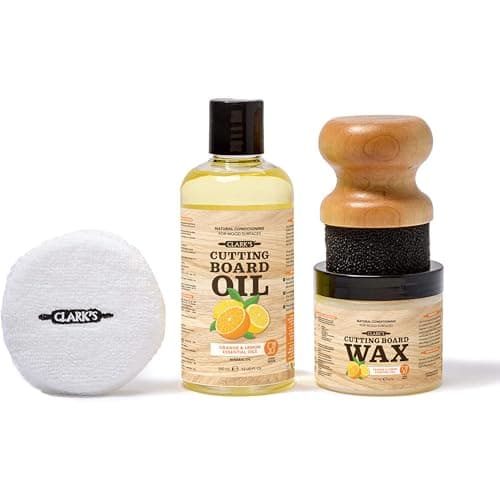
Care
Wooden cutting board care
The four-minute routine that decides whether a board lasts one year or thirty.
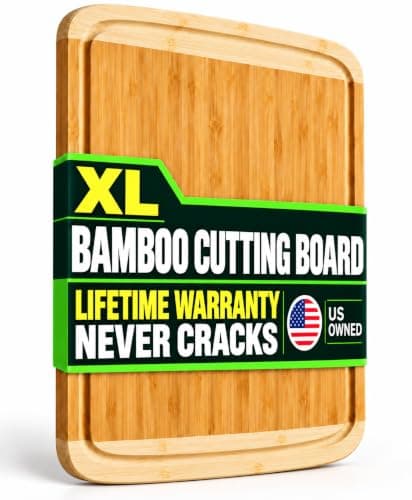
Comparison
Bamboo vs wood cutting boards
What bamboo is, what the hardness numbers actually say, where glue lines fail, and which board to buy for chopping versus serving.