Care guide
How to keep sterling silver from tarnishing
Wear it, and store it sealed and dry when you are not. Tarnish is a sulphur reaction with the air, not dirt and not a defect — which is why an airtight bag does more for a silver piece than any amount of polishing, and why every polish takes a little of the silver with it.
We earn a commission when you buy through our Amazon links, at no extra cost to you. It never changes the order of the picks, and we say so when the cheaper thing is the better buy. How this works.
What tarnish actually is
Tarnish is not dirt, and it is not rust. The Canadian Conservation Institute describes the black layer on silver as mainly silver sulphide, formed when sulphur-containing compounds in the air — hydrogen sulphide in particular — react with the metal surface. When the layer is thin it shows as gold, blue or purple before it goes black, which is why a piece sometimes looks faintly iridescent on the way to looking dull.
Two things follow from that. First, this is an air reaction, so a sealed piece barely tarnishes and an open jewellery dish in a humid bathroom tarnishes fast. Second, it is a surface layer and a very thin one, so the fix is gentle and the real work is prevention. Silver does not corrode through the way iron does; a tarnished piece is intact underneath.
Pure silver is also soft, which is why jewelry is sterling — 92.5% silver with about 7.5% copper for strength. The copper matters for everything below: it is a second metal with its own reactions, and it is the one responsible for green fingers. Sterling silver vs stainless steel covers what the alloy buys you and what it costs.
Why it turns your finger green
This is a different reaction from tarnish and it gets blamed on fake silver constantly. The copper in the alloy reacts with sweat, skin oils and acids — and with hand cream, soap residue and chlorinated water — producing copper salts that are green and that transfer to skin. It is cosmetic, it washes off, and it is not evidence that a piece is plated or fake. If anything, solid sterling is a cleaner situation than plated jewelry, where the base metal underneath a worn coating does the same thing and worse.
What makes it worse in practice is moisture trapped against skin: a ring worn through hand-washing, swimming, or a workout. The whole fix is to take rings off before water and before lotion, and to dry your hands properly with the ring off. If a reaction is itchy, raised or spreading rather than a green mark that washes away, that is a skin question for a doctor rather than a metal question.
What actually prevents it
Four habits, in order of how much difference they make.
- Wear it
- The single most effective thing, and the most counter-intuitive. A piece in regular contact with skin and fabric gets its surface constantly, gently burnished, which is why an everyday band stays bright and an identical one in a drawer for a year goes dull.
- Store it sealed, dry and dark
- A closed bag or box with the air shut out, not an open dish. Conservation practice goes further and adds a desiccant and activated charcoal inside the bag to take the moisture and the sulphur gases out of the air around the piece, which is exactly what anti-tarnish strips do.
- Keep it away from the things that accelerate it
- Rubber bands and some plastics outgas sulphur compounds and will blacken silver in contact. Wool, felt and some papers can do the same. So can eggs, onions, mustard and chlorinated pool water. A bathroom is the worst room in the house for silver because of the humidity.
- Last on, first off
- Perfume, hairspray, sunscreen and lotion all go on before the jewelry, not after. This one habit removes most of the chemistry that causes both tarnish and green skin.
Every pick below is on Amazon Handmade unless the card says otherwise, and every price is the live one. If you want the rules we apply before anything gets listed, they are on how we pick.
What we would buy on that basis
Quick picks
| # | Product | Best for | Provenance | Price |
|---|---|---|---|---|
| 01 | 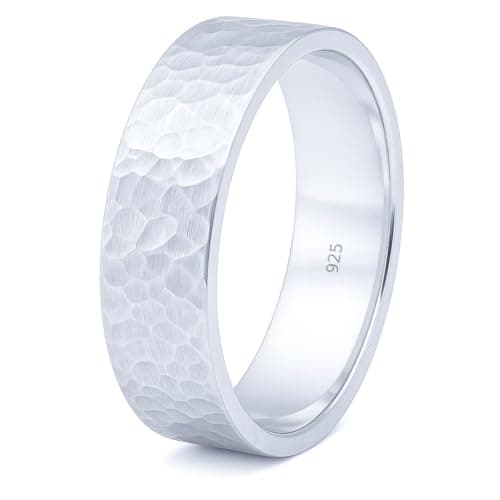 Hammered Sterling Silver Pipe-Cut Band, 6 mm A plain hammered 6 mm band offered across US sizes 4 to 13, for either hand. | the one case where you know the size — a replacement, or a ring they chose | Amazon Handmade | $46.90Amazon (affiliate link) |
| 02 | 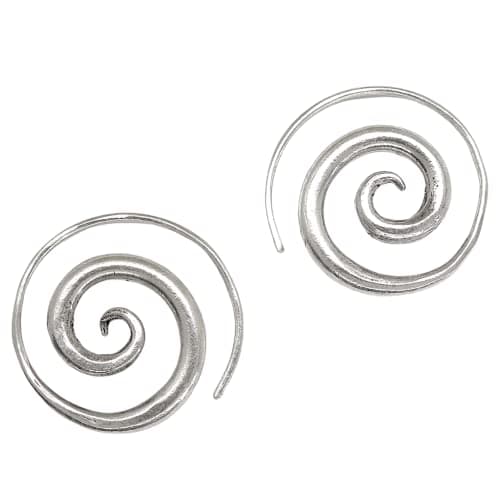 Sterling Silver Thick Spiral Hoops Heavy forged sterling with a hammered finish — no stones, no plating, no delicacy. | the person whose taste is closer to sculpture than to sparkle | Amazon Handmade | $62.00Amazon (affiliate link) |
| 03 | 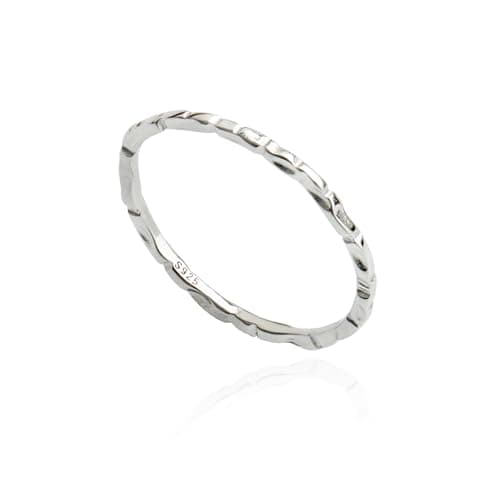 Hammered Sterling Silver Stacking Ring Set Skinny hammered knuckle bands meant to be worn several at a time. | someone who already wears rings and wants more of them | Amazon Handmade | $15.99Amazon (affiliate link) |
#ad · Live prices from the Amazon Creators API, as of October 25, 2026. Where we hold no verified live price we show none — a gap beats a number that has rotted.
The picks, in full
Hammered Sterling Silver Pipe-Cut Band, 6 mm
For a band worn daily, which is the least tarnish-prone thing you can own. A plain hammered 6 mm band offered across US sizes 4 to 13, for either hand.
When the size is known, a properly fitted closed band beats every adjustable compromise on this page: it sits level, it does not spin, and it can be worn every day for years. Six millimeters is the width that works on most hands without becoming a wedding band, and a size run from 4 to 13 covers both the person it is for and whoever else it ends up fitting.
Worth knowing first
Fixed size, so it needs a real measurement. A silver band of this width can be resized by a jeweler, but that is a trip and a fee.
Price as of October 25, 2026. Prices move, and the one on Amazon is the one that counts.
#ad we may earn a commission from this link to Hammered Sterling Silver Pipe-Cut Band, 6 mm
Sterling Silver Thick Spiral Hoops
For earrings that live in a dish by a sink, which is the worst place for them. Heavy forged sterling with a hammered finish — no stones, no plating, no delicacy.
Most handmade silver on the marketplace is thin wire and a bead. This is thick stock, formed and hammered, which is a different skill and a different object: it has weight in the hand and a surface that catches light unevenly. Unisex by design. It is the pair to buy for someone who finds conventional jewelry fussy.
Worth knowing first
Genuinely heavy for an earring. If the recipient prefers something they forget they are wearing, choose the leverbacks instead.
Price as of October 25, 2026. Prices move, and the one on Amazon is the one that counts.
#ad we may earn a commission from this link to Sterling Silver Thick Spiral Hoops
Hammered Sterling Silver Stacking Ring Set
For a hammered finish, where light tarnish in the texture is part of the look. Skinny hammered knuckle bands meant to be worn several at a time.
Stacking rings change the sizing problem rather than solving it: thin bands sit comfortably over a wider range than a wide band does, and the look works whether two or four are on at once. Hammered rather than smooth, which is what keeps them from reading as wire. Sixteen dollars makes this the best value on the page for someone who is already a ring wearer.
Worth knowing first
Thin bands on a knuckle do slide and spin. They are also easy to lose, which is a real consideration for a gift.
Price as of October 25, 2026. Prices move, and the one on Amazon is the one that counts.
#ad we may earn a commission from this link to Hammered Sterling Silver Stacking Ring Set
How to clean it, and what to use
Start with the gentlest thing that works, because every method of removing tarnish takes a little of the underlying silver with it. A silver polishing cloth — the soft impregnated kind — handles light tarnish on a smooth surface in under a minute and is the right first move almost always.
For a piece that is grubby rather than tarnished, warm water with a mild detergent and a soft brush is safe; the CCI notes that washing or swabbing with a mild detergent in distilled water is safe for the object. Rinse properly, dry completely, and do not put it away damp. For heavier tarnish a proper silver polish applied sparingly is the next step, worked along the surface rather than scrubbed in circles.
Three cautions. Textured and hammered finishes are supposed to hold shadow in the recesses — polishing those bright removes the contrast the maker built, and on an intentionally oxidised piece it removes the design outright. Stones have their own rules: porous and soft stones such as turquoise, opal, pearl and raw crystal should not be dipped, soaked or exposed to polish, so clean around them with a cloth. And on anything silver plated, the CCI position is blunt — any method of tarnish removal may be very damaging, because the layer you are polishing is the entire silver content.
The household tricks, and which ones to avoid
- Toothpaste. Avoid. It is an abrasive formulated for enamel, which is far harder than silver. It will take tarnish off and leave a field of fine scratches, and it will strip an oxidised finish.
- Baking soda paste. Same problem, milder. It is still an abrasive and still removes metal. Fine on a plain spoon, bad on a hammered band and worse on a plated piece.
- The foil and hot water trick. This one genuinely works chemically — it converts the sulphide back rather than scraping it off — but it is indiscriminate: it strips intentional oxidation, it can affect stones and glued settings, and the hot water is a risk to anything porous. Leave it for plain silverware.
- Commercial dip solutions. Fast and aggressive. The conservation position is to avoid immersion and dips on composite objects altogether, and a ring with a stone in it is a composite object.
- Anti-tarnish strips in a sealed bag. The one home measure that is unambiguously worth doing, because it prevents rather than removes.
The pieces where this matters least
Not every piece needs a routine. A band worn daily effectively maintains itself. A hammered or textured piece hides light tarnish in its own surface, and many makers oxidise texture deliberately for exactly that contrast. The pieces that actually need storing properly are the smooth, high-polish ones and anything that gets worn occasionally — which is most earrings and nearly all pendants.
If what you are really trying to establish is whether a piece is solid sterling in the first place, how to tell real sterling silver has the stamps, the magnet test and the plating tells. For the range itself, sterling silver carries the pieces that state 925, and handmade rings and handmade earrings are the deeper categories.
Questions people actually ask
Why does sterling silver tarnish?
How do I stop sterling silver from tarnishing?
Why does sterling silver turn my finger green?
Is toothpaste safe for cleaning silver?
Should I use a silver dip?
Does tarnish damage silver permanently?
Sources
Read next
Roundup
Handmade sterling silver
Real 925 from named makers — hoops, drops, pendants and the tarnish question.
Buying handmade
How to tell real sterling silver
The stamp, the legal standard, the words that mean less than they sound, and the checks that work on a listing.
Comparison
Sterling silver vs stainless steel
Three metals that look alike in a photograph and age completely differently. Tarnish, nickel, resizing and repair, with the 925 picks that make the case.
Roundup
Handmade sterling silver rings
Adjustable, wrap and spiral bands that survive not knowing her size — plus how to find the size without asking.
Roundup
Handmade earrings
Sterling, copper, sea glass and pressed flowers, with the closure rule that matters.
Jewelry
Handmade jewelry
925 versus plated, and how to buy jewelry for someone whose taste you half know.